

Pricing Strategy 101 for Home Sellers
Pricing Strategy 101 for Home Sellers is all about understanding how to set a price that attracts strong offers, protects your equity, and helps your home sell in a reasonable time. In the current US housing market, where mortgage rates are still relatively high and inventory is rising in many areas, pricing can matter more than staging, marketing, or even upgrades.
A smart home pricing strategy balances data, buyer psychology, and your personal goals. When you treat pricing like a deliberate strategy instead of a guess, you gain control in a market that can feel unpredictable.
This guide will walk through how to read the market, choose the right price, adjust when needed, and prepare for future trends in US real estate.
Why Pricing Strategy Matters More than Ever in today’s US Housing Market
Pricing Strategy 101 for Home Sellers starts with understanding the big picture. The US housing market has cooled from the frenzy of 2021–2022, but it’s still expensive for buyers because home values remain high and mortgage rates hover around elevated levels compared with the last decade.
Inventory has been climbing in many regions, which means buyers often have more options and more negotiating power. National data shows that a growing share of listings now see at least one price cut before selling, and the typical size of those cuts can be tens of thousands of dollars.
For sellers, this means overpricing your home is riskier than it used to be. Homes that sit on the market tend to get “stale,” pushing buyers to wonder what’s wrong and encouraging lowball offers.
At the same time, underpricing too aggressively can leave money on the table, especially in tight local markets where demand is still strong. A solid pricing strategy for home sellers focuses on hitting a realistic range that works with current buyer budgets and interest rate constraints.
Another key factor is that buyers today are heavily data-driven. They use online portals, recent sales history, and pricing alerts to track what’s happening in a neighborhood. Many know if a home has been reduced or relisted.
That transparency makes it harder to “test” unrealistic numbers without consequences. Pricing Strategy 101 for Home Sellers recognizes that your first list price sends a powerful signal. It tells buyers whether you’re serious, flexible, or out of touch with the market.
Getting that signal right—from day one—can be the difference between a quick, strong sale and months of stressful price cuts.
How High Rates and Shifting Demand Affect your Pricing Power

Your home pricing strategy doesn’t exist in a vacuum; it lives inside a financial environment shaped by mortgage rates, inflation, and buyer confidence. When rates are high, buyers’ monthly payments jump dramatically for the same loan amount.
That means many buyers have to choose between smaller homes, cheaper locations, or negotiating harder on price. Economic outlooks for the US housing market in 2024–2025 suggest modest price growth overall but with big differences between regions and price points.
For home sellers, higher rates often reduce bidding wars and all-cash offers outside of very hot micro-markets. Instead of dozens of showings in a weekend, you might see a slow but steady trickle of qualified buyers.
Pricing Strategy 101 for Home Sellers teaches that in this environment, being slightly more competitive on price can pull buyers in who are payment-stretched.
For example, shaving a few thousand dollars off the list price may allow a buyer to qualify for financing or feel comfortable with their monthly payment, especially when property taxes and insurance are included.
Shifting demand is another big piece of the puzzle. Some suburban and Sun Belt markets still see strong inflows of remote workers and retirees, while certain high-cost coastal areas are normalizing or even softening.
Local job growth, commute patterns, and new construction all influence how much pricing power you really have. A smart home pricing strategy looks at hyper-local trends—days on market, list-to-sale ratios, number of active listings—rather than just national headlines.
When you tailor Pricing Strategy 101 for Home Sellers to your zip code, you decide whether you can price at the higher end of the range or need to be sharper to stand out.
What current data says about list price, discounts and time on market
Recent data from major real estate research providers shows an important shift: a rising share of homes need price cuts to sell. Zillow and other platforms have reported that roughly a quarter or more of active listings see at least one price reduction, with the average cumulative cut around $25,000 in some months.
In higher-priced markets like San Jose, Los Angeles, and New York, the typical discount can be even larger. That doesn’t mean your home will automatically sell below the list, but it does show how sensitive buyers are to initial pricing.
At the same time, the sale-to-list ratio—a key metric in Pricing Strategy 101 for Home Sellers—has come closer to 100% in many areas after previously exceeding it during the peak seller’s market, when homes often sold above asking.
A sale-to-list ratio near or below 100% means buyers are negotiating more and sellers are compromising. Days on market have also lengthened compared with the pandemic boom, though certain hot neighborhoods and starter-home segments still move fast.
For home sellers, these trends translate into a clear takeaway: your first list price should be grounded in reality, not wishful thinking. If comparable homes in your area are closing at 98% of the list after one price reduction, your own home pricing strategy should acknowledge that pattern.
You might list a bit tighter to avoid a public price cut, or you may plan one strategic reduction after a set period if showings are weak. Pricing Strategy 101 for Home Sellers isn’t about hitting a perfect number; it’s about using market data on list prices, discounts, and time on market to position your property where serious buyers are ready to act.
Core concepts in Pricing Strategy 101 for Home Sellers
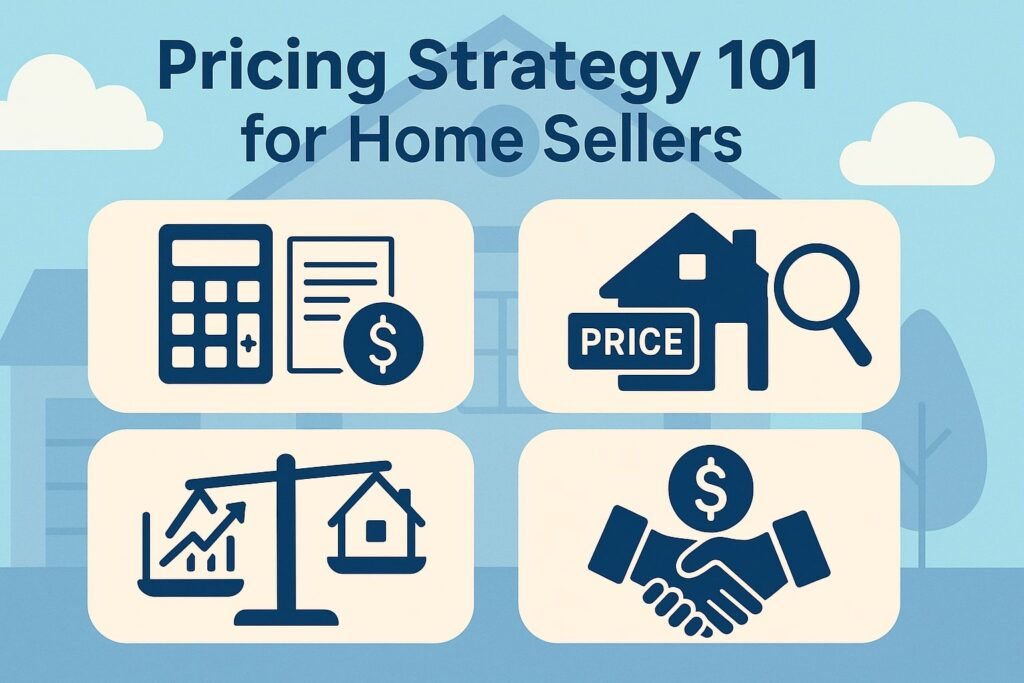
Before you adopt any home pricing strategy, you need to understand the core terms and metrics. Pricing Strategy 101 for Home Sellers centers around the idea of “market value,” essentially what a qualified buyer is willing to pay and what you’re willing to accept at a given moment.
That value is influenced by location, condition, size, features, and broader economic factors. It’s not just what you “need” to get or what an online tool says.
You’ll encounter several related concepts: list price (your asking price), sale price (what you actually get), and the gap between them, which is captured in the sale-to-list ratio. You’ll also see appraised value, which the lender’s appraiser determines, and assessed value, which local tax authorities use.
These numbers influence each other but rarely match exactly. A good pricing strategy for home sellers understands how each figure fits into the process, from attracting buyers online to clearing the appraisal step at closing.
Another foundational concept in Pricing Strategy 101 for Home Sellers is elasticity—how sensitive buyers in your area are to price changes. In some neighborhoods, a $10,000 difference barely affects interest; in others, dropping just $5,000 can move your listing into a more active price band.
Online search filters, psychological price thresholds, and pre-approval limits all affect elasticity. When you see your home as a product competing with similar “inventory,” you can start to think strategically about where your price sits relative to the pack.
List price, sale price, and the sale-to-list ratio
Your list price is the number that hits the MLS and all the major portals. It’s what buyers see on their phones and what agents use in listing alerts. The sale price, by contrast, is the final number on your closing statement after negotiations, inspections, and any seller concessions.
Pricing Strategy 101 for Home Sellers focuses on the relationship between these two figures because that relationship reveals whether you priced correctly from the start.
The sale-to-list ratio is calculated by dividing the sale price by the list price and expressing it as a percentage. A ratio above 100% means homes are selling for more than asking, which often happens in hot seller’s markets with multiple offers.
A ratio under 100% means homes usually close for less than list, indicating more negotiating room for buyers. Local real estate data, often provided by MLS feeds, Redfin, or other platforms, tracks this metric by city, neighborhood, and price range.
For individual home sellers, the goal is not necessarily to get a 105% sale-to-list ratio. Instead, it’s to choose a list price that positions you to receive strong, realistic offers without long delays. If homes similar to yours are selling around 99% of the list after 30 days on market, a home pricing strategy that aims for 98–100% of the list within that window is sensible.
If your area still sees 101–103% sale-to-list, you might be able to push your list price a bit higher, but you must be ready for quick buyer feedback. Pricing Strategy 101 for Home Sellers teaches you to use this ratio as a compass, helping you decide whether your price is aligned with how the market is actually behaving.
Market value vs. appraised value vs. assessed value
It’s common for home sellers to confuse market value, appraised value, and assessed value, which can derail a good pricing strategy. Market value is the most important for Pricing Strategy 101 for Home Sellers.
It’s basically what an informed, willing buyer will pay under normal conditions. Market value reflects recent comparable sales, current competition, and buyer sentiment. It changes faster than most people realize—sometimes month to month.
Appraised value is what a licensed appraiser determines, usually on behalf of a lender. The appraiser uses recent comparable sales, condition, and standard guidelines to decide if the agreed-upon purchase price is reasonable collateral for the loan.
If your sale price is much higher than the appraised value, the deal can run into trouble unless the buyer brings extra cash or you renegotiate. That’s why a rational home pricing strategy keeps potential appraisal limits in mind, especially in areas where prices have jumped quickly.
Assessed value comes from your local government for property tax purposes. It may be tied loosely to market value but is often out of date or constrained by assessment rules and caps. Many sellers mistakenly think they should base their list price on assessed value, but this number is usually not accurate enough for Pricing Strategy 101 for Home Sellers.
Instead, treat assessed value as a reference point buyers might see in public records, not as the main guide. When you understand the difference between these three values, you can set a price rooted in real, current market behavior while also anticipating the appraisal step and buyer perceptions.
Doing your homework: research that drives a winning home pricing strategy
Research is the backbone of Pricing Strategy 101 for Home Sellers. Before you pick a number, you should know exactly what buyers see when they open a search within your neighborhood and price range. Your first task is to gather recent comparable sales, often called “comps.”
These are homes similar to yours in size, condition, age, and location that have sold recently—ideally within the last three to six months. You’ll compare list prices, sale prices, days on market, and any reported concessions to see where the market is clearing.
But pricing strategy for home sellers goes beyond comps. You should also look at active listings (your current competition) and pending sales (homes under contract). Active listings show you what other sellers are asking right now; pending sales tell you which prices buyers are actually accepting.
This combination helps you identify the “sweet spot” where homes are attracting offers. Tools from sites like Zillow, Realtor.com, and brokerage data dashboards, along with Redfin’s downloadable housing market data, give additional context on trends in your metro area, such as median sale price, inventory, and days on market.
A thorough home pricing strategy also considers seasonality and timing. In many parts of the US, spring and early summer bring more buyers, while late fall and winter can be slower. However, in hot job-growth markets or warm-weather regions, the patterns may differ.
Pricing Strategy 101 for Home Sellers suggests aligning your price not just with today’s comps but with the expected demand in the month you list. If you’re listing during a slower period, being slightly more competitive on price can help your home stand out among fewer, choosier buyers.
Using comps, online estimates, and local data the right way
Comps are foundational in Pricing Strategy 101 for Home Sellers, but not all comps are created equal. The best comparables are in the same neighborhood, school district, and micro-location, ideally within a few blocks of your property. They should be similar in square footage, bedroom and bathroom count, lot size, and age.
You’ll also want to consider upgrades like renovated kitchens, finished basements, or added bathrooms. When possible, use homes sold very recently; in a changing market, sales older than six months may be less reliable.
Online estimate tools—like Zestimates and similar automated valuation models (AVMs)—can be helpful starting points but shouldn’t dictate your entire home pricing strategy. These tools pull from public records and past sales but may not “see” your upgrades, condition, or unique features.
They also struggle with unusual properties, rural homes, or rapidly shifting markets. Research from real estate platforms and industry experts consistently emphasizes combining AVMs with local agent insight for the most accurate pricing.
Local data goes beyond just comp addresses and prices. Look at the number of active listings at your price point, how long they’ve been on the market, and how often they’re reducing prices. Pay attention to whether homes are selling near or below list, and if certain features (like updated roofs or energy-efficient systems) command a premium.
When you integrate comps, online estimates, and granular local insights, you’re applying Pricing Strategy 101 for Home Sellers in the way it’s meant to be used: as a data-driven roadmap rather than a guess.
Factoring condition, upgrades, and timing into your price
Two homes can have the same floor plan and square footage yet justify very different prices because of condition and upgrades. Pricing Strategy 101 for Home Sellers urges you to be brutally honest about how your home compares.
If your property needs a new roof, has original 1990s finishes, or shows deferred maintenance, it may not command the same price per square foot as a fully updated neighbor. Buyers notice worn carpets, dated tile, and older systems, particularly when monthly payments are already stretched by higher interest rates.
On the flip side, strategic upgrades can support a stronger home pricing strategy. Renovated kitchens and bathrooms, new flooring, fresh paint, and enhanced curb appeal all help your home compete.
Energy-efficient features like new windows, insulation, or solar panels can also add appeal, especially to eco-conscious buyers worried about utility costs.
However, not every upgrade returns dollar-for-dollar value, so you shouldn’t automatically add the full cost to your price. Instead, look at comps that share similar improvements and see how they sold.
Timing can also change your price calculus. If you need to relocate quickly for a job, a sharper list price may be worth it to avoid months of carrying costs and uncertainty. If you have flexibility and your local market is improving, you might price toward the higher end of the justified range and see how buyers respond.
The key idea in Pricing Strategy 101 for Home Sellers is that your price should reflect reality: the reality of your home’s condition, the upgrades buyers care about, and the timeline you’re working with.
Popular pricing strategies for home sellers (and when to use them)
There is no single “right” home pricing strategy for every seller. Instead, Pricing Strategy 101 for Home Sellers offers several approaches, each suited to different markets and goals. The most common strategies are pricing at fair market value, pricing slightly below to spur competition, and pricing above market to “test” demand.
There are also more creative approaches, such as using price bands, auction-style pricing, or even ultra-low teaser prices that attract attention and bids.
Choosing among these strategies depends on your local market conditions and your tolerance for risk. If supply is tight and buyers are still aggressive, pricing slightly below market can produce multiple offers.
In balanced or buyer-leaning markets, pricing at market value or even slightly under may be necessary just to get showings. Pricing significantly above market is usually risky now, given the level of buyer data and the frequency of price cuts reported in recent housing reports.
The best pricing strategy for home sellers is often a hybrid. You might list near the middle or upper end of the comps’ range but commit in advance to a price reduction if you don’t hit specific showing or offer benchmarks in the first 2–3 weeks.
That way, you’re not locked into a stubborn number; you’re following a plan that responds to actual buyer behavior. Pricing Strategy 101 for Home Sellers emphasizes that flexibility plus preparation almost always beats a rigid, emotionally driven price.
Pricing at market value or slightly below to spark competition
Pricing at fair market value is the classic approach in Pricing Strategy 101 for Home Sellers. You find a realistic range based on recent comps, condition, and market trends, then choose a price that sits right in the middle.
This strategy sends a message to buyers and agents that you’re informed and serious. It’s ideal in balanced markets where neither side has a clear edge, and you want to attract qualified buyers without signaling desperation.
Pricing slightly below market is more aggressive but can pay off in the right conditions. When inventory is low and demand is fairly strong, a home pricing strategy that lists just below similar recent sales creates a sense of value and urgency.
Buyers see your property as “the deal” among the competition and may rush to tour and submit offers. In some cases, this approach can produce bidding wars that drive the final price above your list and sometimes above the midpoint of market value.
Recent years have seen many examples of this behavior in desirable US metros and neighborhoods, particularly for entry-level homes and renovated properties.
However, this strategy isn’t a magic trick. If your home is significantly less updated than others or your local demand has cooled, pricing below market value may just result in a lower sale price, not multiple offers.
That’s why Pricing Strategy 101 for Home Sellers stresses careful research. Use the slightly-below-market approach when your home is objectively competitive and your local data shows strong showings and rapid sales at similar price points.
Testing the market with aspirational pricing (without getting burned)
Aspirational pricing—listing somewhat above the likely market value—can be tempting, especially when you’ve built equity and feel your home is special. In Pricing Strategy 101 for Home Sellers, this approach is considered high-risk in today’s more cautious environment.
With buyers watching every dollar of their monthly payment and online platforms tracking price cuts, overpricing can quickly backfire. National and local data show a meaningful share of homes now undergo at least one price reduction, and those “reductions” are often a response to initial overpricing.
That doesn’t mean you can never test the market. In a truly unique property—think an architectural gem, a rare lot, or a home in a micro-neighborhood with little competition—slightly aspirational pricing may be reasonable. The key is discipline. Before you list, decide specific metrics that will trigger a price adjustment.
For example, if you receive fewer than ten showings and no serious interest within the first 21 days, you’ll lower the price to a predetermined level closer to your home pricing strategy’s core estimate.
Aspirational pricing without a plan often leads to a painful cycle: long days on market, repeated cuts, and ultimately a lower sale price than if you had priced correctly from the start. Buyers may assume something is wrong with a home that’s been on the market much longer than others or that has slashed its price multiple times.
Pricing Strategy 101 for Home Sellers encourages you to be honest about whether aspirational pricing fits your situation or whether a cleaner, data-backed price will serve you better.
Creative strategies: price bands, auction-style pricing, and $1 listings
Beyond classic approaches, some sellers and agents experiment with creative pricing strategies. One is price band positioning. Many home search sites let users filter by broad price ranges, like $400,000–$450,000 or $450,000–$500,000.
Pricing Strategy 101 for Home Sellers suggests checking where the natural price bands fall and positioning your home just inside a popular band. For example, listing at $449,900 rather than $455,000 may expose your home to more buyers searching “up to $450,000.”
Auction-style pricing is another tactic. You intentionally price the home lower than expected, sometimes at an eye-catching “starting price,” to attract multiple offers within a short deadline.
This home pricing strategy can work well in high-demand neighborhoods and for homes with broad appeal. However, it requires careful management and clear instructions to buyers and agents, so it’s typically best executed with an experienced listing agent.
In some US markets, a small number of sellers and agents have even used symbolic “$1 listing” strategies, where the asking price is set extremely low to drive attention and let the market decide the actual value through competitive bidding.
Recent news stories show examples of homes listed at $1 and eventually selling for hundreds of thousands of dollars after intense buyer interest. While this can generate media buzz, it’s not a typical or necessary strategy in Pricing Strategy 101 for Home Sellers.
It may confuse buyers, complicate appraisal expectations, and is best seen as a niche marketing gimmick rather than a mainstream pricing method for most US home sellers.
Psychology of home pricing: how buyers actually think
Numbers on a screen may seem cold and rational, but human psychology plays a huge role in Pricing Strategy 101 for Home Sellers. Buyers don’t just evaluate your home’s square footage and features; they react emotionally to perceived fairness, opportunity, and fear of missing out.
Understanding these psychological drivers can help you shape a home pricing strategy that feels compelling rather than off-putting.
One core concept is anchoring. Your list price becomes the mental anchor from which buyers adjust their expectations. If you price far above comparable homes, buyers may feel you’re unreasonable and skip viewing your property altogether.
If you price slightly under the competition, buyers may anchor your home as “the one to beat” and mentally justify stretching to win it. Pricing Strategy 101 for Home Sellers uses anchoring deliberately by setting a price that frames your home as a good value, even if it’s not the absolute cheapest.
Another psychological factor is perception of risk. When buyers see a home that’s been on the market for months or has multiple price cuts, they may worry that something is wrong with it. That perception can overshadow real inspection results.
By contrast, a fresh, fairly priced listing communicates less risk and more opportunity. Your home pricing strategy should aim to keep your listing in that “fresh and fairly priced” zone as long as possible, using early feedback to adjust before negative perceptions harden.
Price anchoring, charm pricing, and the power of round numbers
Anchoring is just one piece of pricing psychology. Charm pricing—such as listing at $499,900 instead of $500,000—also appears in Pricing Strategy 101 for Home Sellers. This style of home pricing strategy takes advantage of how buyers read numbers quickly.
Many see $499,900 as meaningfully cheaper than $500,000, even though the difference is small. It can make your listing appear more competitive when buyers skim search results.
However, you must balance charm pricing with the way online search filters work. Some buyers search “up to $500,000,” meaning a $500,000 list price will be included but $505,000 will not.
At the same time, others search starting from $500,000 upward, so a $499,900 price might be missed. Pricing Strategy 101 for Home Sellers suggests experimenting with both charm and clean round-number pricing depending on your market’s price bands and buyer habits.
Round numbers also carry meaning. A home priced at $600,000 instead of $599,900 can communicate confidence and clarity, especially in upper price brackets where buyers are more analytical.
In that segment, your home pricing strategy might prioritize clean prices that line up with lender pre-approval tiers, making it easier for buyers and agents to place your home in their mental hierarchy. Whatever you choose—charm or round—be intentional.
Your price is part of your home’s story; Pricing Strategy 101 for Home Sellers encourages you to write that story thoughtfully.
Online search filters and how they shape buyer behavior
Most buyers today start their home search online, using filters for price range, beds, baths, and location. This is why Pricing Strategy 101 for Home Sellers pays close attention to how those filters shape demand.
Your home pricing strategy should consider the thresholds that buyers most commonly use. For example, many first-time buyers search “up to $400,000” or “up to $500,000,” while move-up buyers may filter “$600,000–$800,000.”
If you list your home at $505,000, you might miss all the buyers searching up to $500,000, even if $505,000 is still within their realistic budgets. Similarly, a list price of $801,000 could exclude you from buyers who set their maximum at $800,000.
To apply Pricing Strategy 101 for Home Sellers effectively, look at your key local price bands: which ranges have the most active listings and fastest sales? That’s where you want to position your home so it appears in as many relevant searches as possible.
You should also think about how filters interact with photos, descriptions, and days on market. A competitive home pricing strategy ensures your home doesn’t just show up in searches—it stands out.
A slightly sharper price relative to similar homes can help your listing rank higher in buyers’ minds when they scroll. Combined with strong photos and a compelling description, your price can signal “this is worth seeing in person,” which is exactly what you want.
Monitoring the market and adjusting your price
Even the best initial price is just a starting point. Pricing Strategy 101 for Home Sellers teaches that monitoring real-time feedback is crucial. Once your home is on the market, you’ll receive information through showing volume, online views, open house traffic, and direct feedback from agents and buyers. A strong home pricing strategy views this feedback as data, not criticism.
If you’re getting frequent showings and positive feedback but no offers, buyers may like the home but feel the price is just slightly too high compared with alternatives. If showings are sparse and online saves are low, your list price or marketing may be off by more than just a few thousand dollars.
In a shifting US market, sellers who respond quickly to these signals typically fare better than those who wait months to adjust. Industry reports show that homes that require large, late price cuts often sell for less than similar properties that were priced correctly early on.
Your agent (if you have one) should help interpret these signals and compare them with broader market data. For example, if everything is slow in your segment due to interest rate spikes or local economic news, your home pricing strategy might call for patience and smaller, staged adjustments.
If comparable homes are selling and yours is not, a bolder price change may be needed. Pricing Strategy 101 for Home Sellers emphasizes staying proactive, not reactive, as your listing moves through its life cycle.
Reading the signals: showings, feedback and days on market
In practice, how do you “read” the market once your home is listed? Pricing Strategy 101 for Home Sellers suggests tracking a few key metrics weekly. First, count the number of showings and inquiries.
In a healthy, balanced market, a competitively priced home should see multiple showings in the first week or two. If you launch and hear crickets, it’s a sign your home pricing strategy may be misaligned.
Next, pay attention to feedback from buyers and agents. Are people consistently saying the home is smaller than expected, needs too much work, or feels overpriced compared to others they’re seeing?
One negative comment is just an opinion; a pattern is data. If your price is at the top of the range for your neighborhood, and people keep comparing you to cheaper, better-updated homes, it may be time to adjust.
Finally, track days on market (DOM) compared with the neighborhood average. If typical homes like yours go under contract in, say, 20–30 days and you’re at day 40 without serious interest, your pricing strategy for home sellers should include a review and likely a price change.
Online platforms often highlight how long a property has been listed, and buyers use long DOM as a negotiation tool. Pricing Strategy 101 for Home Sellers advises acting before your listing becomes “old news,” using data-driven decisions rather than wishful thinking.
Smart price reductions and repositioning your listing
Price reductions are not failures; they’re tools in a flexible home pricing strategy. The key is to make reductions strategic and meaningful. Pricing Strategy 101 for Home Sellers recommends avoiding tiny reductions that don’t move your home into a new price band or change buyer perception.
A $1,000 cut on a $500,000 home rarely makes a difference. Instead, aim for reductions that position your home more competitively and expose it to new groups of buyers via search filters.
For example, moving from $515,000 to $499,900 can place your home into the “up to $500,000” searches and signal a stronger value. If your agent can tie the reduction to new marketing—fresh photos, rewritten description, or an open house—you can essentially relaunch the property.
Many US housing market updates note that sellers who make timely, well-structured price cuts often see renewed interest, especially when overall inventory is rising and buyers are watching closely for value.
Repositioning your listing can also mean adjusting more than price. You might highlight different features, update staging, or emphasize flexible closing dates or credits for repairs. A good home pricing strategy is integrated with your overall selling strategy; price doesn’t operate alone.
Pricing Strategy 101 for Home Sellers suggests approaching any change—whether it’s a $10,000 reduction or a new marketing angle—as part of a clear plan based on data and buyer behavior.
Working with real estate pros and technology on pricing
You don’t need to navigate Pricing Strategy 101 for Home Sellers alone. A skilled real estate agent or broker can bring hyper-local knowledge that no online tool can fully match.
Agents see, often before the public data does, how quickly homes go under contract, what concessions sellers are making, and what prices appraisers are supporting. They can help you interpret your home’s unique strengths and weaknesses in the context of your specific neighborhood and price segment.
At the same time, technology now offers powerful tools for home pricing strategy. Automated valuation models, AI-powered pricing engines, and market dashboards can crunch massive amounts of data in seconds.
They show trends in list-to-sale ratios, days on market, and price cuts at granular levels. The best modern approach combines human expertise with data tools. Industry guides for 2024 and beyond emphasize using both—agents plus analytics—to set realistic, competitive prices.
When you collaborate with professionals and technology, you gain a more complete picture. Your agent can challenge or confirm AVM estimates based on what they’ve seen recently in your area.
You can use tech tools to monitor changing conditions even after you list, adjusting your home pricing strategy as new data rolls in. Pricing Strategy 101 for Home Sellers encourages you to see pricing as a partnership between your goals, expert advice, and evidence from the market.
How agents build a Comparative Market Analysis (CMA)
A Comparative Market Analysis (CMA) is one of the primary tools agents use in Pricing Strategy 101 for Home Sellers. The CMA looks at recent sales, active listings, and pending contracts to estimate your home’s probable selling price.
Unlike automated online estimates, a CMA allows for detailed human judgment about your property’s condition, upgrades, and micro-location.
Your agent will typically start by gathering 5–10 comparable properties that share your home’s core characteristics: location, size, age, and style. They may then adjust for differences, such as extra bathrooms, finished basements, larger lots, or renovated kitchens.
They also look at how long each property was on the market, whether there were price reductions, and whether the home sold over or under list. Guides from Realtor.com and other industry sources stress that a robust CMA is central to a solid home pricing strategy in 2024 and beyond.
You should review the CMA with your agent as part of your Pricing Strategy 101 for Home Sellers planning session. Ask questions about why certain properties were chosen and how adjustments were made.
Look not only at final prices but at trends—are newer, updated homes selling faster? Are fixer-uppers sitting longer? This conversation can help you decide whether to list at the middle, low, or high end of the recommended range. A CMA isn’t a guarantee, but it’s one of the most practical, proven tools for building a data-based home pricing strategy.
Using AVMs, AI tools and data platforms without becoming a “zestimate zombie”
Automated valuation models (AVMs) and AI-powered pricing tools are now standard parts of the real estate landscape. They use algorithms and large datasets to estimate home values rapidly.
Platforms like Zillow, Redfin, and others offer public estimates, and brokerages often have internal tools. These are valuable inputs for Pricing Strategy 101 for Home Sellers, but they’re not infallible.
AVMs can be very accurate in neighborhoods with many recent sales of similar homes. However, they can struggle with unique properties, rapidly changing markets, or incomplete data (for example, recent renovations not reflected in public records).
Industry articles on pricing your home highlight that online estimates should be a starting point, not the final word in your home pricing strategy.
To avoid becoming a “zestimate zombie,” use multiple data points. Check several AVMs, compare their ranges, and then layer in agent insight, a CMA, and your own knowledge of your home’s condition.
Look at local housing reports and trend dashboards rather than focusing only on a single estimated value. Pricing Strategy 101 for Home Sellers suggests using tech tools as a compass, not as a dictator.
When algorithms and on-the-ground experience align, you can feel more confident about your pricing strategy. When they diverge, lean into deeper research and professional advice.
Common pricing mistakes home sellers must avoid
Even in an information-rich market, sellers often make the same pricing errors. Pricing Strategy 101 for Home Sellers aims to help you sidestep these traps. One common mistake is letting emotions drive prices.
Homeowners may anchor on what they paid, what they spent on upgrades, or what they “need” to net, even if the current market doesn’t support that figure. The market doesn’t care about your past costs; it cares about today’s buyer demand and comparable sales.
Another frequent mistake is relying solely on one data source, such as a single online estimate or an outdated appraisal. As we’ve seen, a strong home pricing strategy triangulates among comps, AVMs, CMAs, and local trend reports.
It also updates as new sales close and inventory changes. Industry insights from 2024 show that sellers who ignore changing conditions and “stick to their number” often face price reductions and longer days on market, while flexible sellers typically achieve smoother transactions.
A third error is failing to coordinate pricing with presentation. Overpricing a home that’s cluttered, poorly staged, or difficult to show is especially risky. Buyers make quick judgments; if the home feels inferior to similarly priced options, they will pass.
Pricing Strategy 101 for Home Sellers reminds you that price and presentation are intertwined. A fair price plus appealing photos, clean staging, and easy showing access often outperforms a higher price with subpar presentation.
Letting emotions, myths, and sunk costs drive your list price
Sellers are human, and homes are deeply emotional assets. But Pricing Strategy 101 for Home Sellers warns that emotional pricing is one of the biggest threats to a successful sale. You might feel your home is worth more because of memories, personal design choices, or the sweat equity you’ve invested.
While these factors matter to you, they may not translate into dollars for buyers. If your home pricing strategy starts with “I need at least X,” it’s time to step back and refocus on what the market is truly willing to pay.
Myths can also distort your list price. Some sellers believe they should always start high because “buyers will negotiate down.” In today’s data-rich environment, overpriced homes are more likely to be ignored than negotiated over.
Other myths include “spring is always the best time to sell” or “I can add every dollar I spent on upgrades to the price.” Pricing Strategy 101 for Home Sellers tackles these assumptions with real data and realistic expectations about buyer behavior.
Sunk costs—the money you’ve already spent—can be especially dangerous. You might feel compelled to recoup every dollar of a past renovation or purchase price, even if the market no longer supports it. Economists call this the “sunk cost fallacy.”
A wiser home pricing strategy focuses on marginal decisions: given today’s market and your current situation, what price and terms make the most sense going forward? That mindset allows you to sell strategically rather than clinging to past numbers that no longer reflect reality.
Overpricing in hot markets and underpricing in slow ones
Counterintuitively, hot markets can tempt sellers to overprice, while slow markets sometimes nudge sellers to underprice out of fear. Pricing Strategy 101 for Home Sellers addresses both risks. In a hot market, you may see headlines about homes selling above list and assume you can ask for almost any number.
However, even in strong markets, buyers are increasingly sensitive to value due to higher mortgage rates and tighter budgets. Overpricing by too much can cause buyers to ignore your listing and flock to slightly better-priced homes, leaving you with fewer offers and eventual price cuts.
In slower markets, some sellers panic and set their list price too low, hoping to “guarantee” a sale. While aggressive pricing can create interest, underpricing significantly below market value may result in leaving serious money on the table, especially if your area still has pockets of strong demand.
A better home pricing strategy for slow markets is to price competitively but not desperately, then adjust based on actual buyer response.
The key insight from Pricing Strategy 101 for Home Sellers is that both hot and slow markets require discipline. Use comps, sale-to-list ratios, and days on market data to calibrate your price.
Don’t assume a hot market will save an unrealistic price, and don’t assume a slow market means you have to give your home away. Balanced, data-driven decisions almost always deliver a better outcome than reactive pricing based on fear or greed.
Future of home pricing strategy in the US
The future of Pricing Strategy 101 for Home Sellers will be shaped by technology, transparency, and evolving buyer expectations. Real estate platforms are already publishing more granular data about price cuts, sale-to-list ratios, and neighborhood-level trends than ever before.
Weekly housing market dashboards from large brokerages provide near-real-time updates on inventory and buyer activity across US metros.
As this data becomes more accessible, home sellers will need to be even more informed. Buyers will quickly spot overpricing and may shy away from properties that don’t align with recent local sales.
At the same time, new pricing models, including dynamic or algorithmic pricing, may begin to appear in residential real estate, similar to what already exists in short-term rentals and some commercial sectors. Home pricing strategy will become more like continuous portfolio management than a one-time decision.
Another factor shaping the future is changing demographics. Younger buyers who grew up with online marketplaces expect transparency, comparables, and instant information. They’re used to seeing price histories, reductions, and competitive listings side by side.
Pricing Strategy 101 for Home Sellers in the coming years will need to account for this expectation of openness and fairness, using clear, data-backed pricing that buyers can easily understand and verify.
Data, AI and real-time pricing tools
AI and machine learning are already transforming pricing strategy in many industries, and residential real estate is no exception.
Emerging tools can analyze large volumes of MLS data, economic indicators, and buyer behavior to suggest list prices and even timing for price adjustments. Reports and industry commentary forecast broader adoption of these tools in the US housing market over the next few years.
For sellers, this means your home pricing strategy may soon include dashboards that show how minor price changes could affect buyer reach and expected days on market in real time.
Some brokerages already use internal AI-powered systems to help agents fine-tune pricing. Pricing Strategy 101 for Home Sellers will increasingly involve interpreting these AI recommendations alongside human judgment, not simply accepting them blindly.
Real-time tools could also help reduce emotional pricing. When you can see, in a simple interface, how pricing 2–3% above market might push your home outside key search filters and increase expected time to sell, you may be more willing to choose a realistic list price.
At the same time, sellers will need to stay vigilant about data quality and bias. AI is only as good as the data it learns from. The best future home pricing strategy will likely blend AI-powered insights, professional experience, and your own knowledge of your home’s unique value.
What rising transparency means for home sellers
Transparency in real estate pricing is increasing. Buyers can see previous list prices, time on market, estimated values, and in many cases, neighborhood-level sales data with a few taps. Pricing Strategy 101 for Home Sellers must adapt to this reality.
Gone are the days when you could quietly test a very high price and then adjust without buyers noticing. Price histories are visible, and buyers often use them as negotiation leverage.
For sellers, rising transparency can actually be an advantage if you use it well. A home pricing strategy grounded in clear, public data helps build trust with buyers. When your list price is obviously aligned with recent sales and your home’s condition, buyers are more likely to view you as reasonable and negotiate in good faith.
Industry resources for 2024 emphasize using transparency to your benefit: showing comps in listing packets, explaining your pricing logic, and highlighting value rather than simply quoting a number.
In the future, we may see more listings that openly share recent comparable sales or even dynamic pricing ranges that adjust slightly based on demand. As transparency grows, hiding behind wishful pricing will become harder.
Pricing Strategy 101 for Home Sellers encourages you to lean into this shift: treat buyers as informed partners, use data as a common language, and let a well-structured home pricing strategy stand on its own merits.
FAQs
Q.1: How do I know if my home is overpriced or underpriced?
Answer: A central question in Pricing Strategy 101 for Home Sellers is whether your list price is too high, too low, or just right. The best clues come from the market’s response.
If your home has been listed for several weeks with very few showings or inquiries, especially in a market where similar homes are getting regular traffic, that’s a strong sign of overpricing.
Buyers may see your home in search results but skip it because they perceive better value elsewhere. Repeated feedback from agents that your home feels overpriced compared with others they’re showing is another red flag.
On the other hand, if you receive multiple strong offers within a few days of listing—especially if they all cluster above your asking price—it might indicate that you underpriced relative to demand.
While underpricing can be part of a deliberate home pricing strategy to spark competition, consistently overshooting buyer interest can leave money on the table.
National data shows that properly priced homes in many US markets tend to sell near their list price within a typical days-on-market window; homes that deviate significantly often reflect mispricing.
To evaluate your current situation, compare your listing’s performance to local norms. Look at how long similar homes are taking to sell and whether they’re reducing prices. Ask your agent to provide updated comps and an honest assessment.
Pricing Strategy 101 for Home Sellers recommends making adjustments based on clear patterns, not on one or two comments. If your home is overpriced, a meaningful price reduction into a more active price band can reset buyer interest.
If offers pour in immediately and far exceed your expectations, you might accept that you underpriced slightly—but you also successfully executed a strategy that minimized stress and maximized competition.
Q.2: Should I price my home higher to leave room for negotiation?
Answer: Many sellers wonder if they should build negotiation “padding” into their price. Pricing Strategy 101 for Home Sellers acknowledges that some negotiation is common in US real estate, but the old habit of inflating the list price just to bargain down is less effective in today’s transparent market.
When buyers can instantly compare your home to recent sales and active listings, an inflated price often pushes them away rather than inviting negotiation. They may never even schedule a showing if your home looks obviously overpriced in their search results.
Instead of automatically adding a large buffer, start by identifying the realistic market value range for your home through comps, CMAs, and local data. If the range is, for example, $480,000–$500,000, a sensible home pricing strategy might be to list at $499,900 or $495,000 depending on competition and your timeline.
This allows for normal negotiation without making your home look out of line with the market. Industry guides for 2024 pricing strategies emphasize that buyers today often favor reasonably priced homes and may come in with offers closer to the list if they feel the starting point is fair.
In short, it’s fine to expect negotiation, but don’t let that expectation justify an unrealistic price. Pricing Strategy 101 for Home Sellers suggests treating negotiation as a tool for fine-tuning, not as an excuse to start far above market value.
A fair, data-backed list price typically attracts more serious buyers, which can create the competition you need to achieve a strong final number—sometimes better than you would have achieved by overpricing.
Q.3: How much do upgrades and renovations really affect price?
Answer: Upgrades and renovations are important parts of a home pricing strategy, but their impact on price is nuanced. Pricing Strategy 101 for Home Sellers explains that some improvements, such as modern kitchens and bathrooms, new roofing, or high-quality flooring, tend to produce stronger returns because buyers see them as high-value, high-cost items.
Energy-efficient upgrades like new windows, insulation, or HVAC systems can also be attractive, especially in regions with extreme weather or high utility costs.
However, not every dollar you spend on upgrades translates to a dollar of added value. Cosmetic updates done shortly before listing—like painting, basic landscaping, or minor repairs—often improve marketability and perceived value, helping support your price rather than drastically increasing it.
Major renovations completed years earlier may have already partly depreciated in buyers’ minds. Local data and agent insights are crucial here; in some neighborhoods, buyers expect a certain level of finish and will pay a premium for it, while in others, they’re more willing to take on projects in exchange for a lower price.
The best approach in Pricing Strategy 101 for Home Sellers is to evaluate your home against nearby sold and active listings. If your upgrades place you clearly above most comps, your home pricing strategy can lean toward the higher end of the market value range.
If your finishes are dated compared with recent sales, you may need to price more competitively—even if you’ve invested heavily over time. The goal is to reflect how buyers actually see your home today, not how much you’ve personally spent or how attached you feel to certain features.
Q.4: Is it better to sell “as-is” at a lower price or fix things first and price higher?
Answer: Deciding whether to sell “as-is” or invest in repairs and updates is a common challenge. Pricing Strategy 101 for Home Sellers suggests starting with a realistic assessment of your budget, timeline, and local buyer expectations.
In some hot markets or very low price segments, buyers will readily take on cosmetic work or minor repairs in exchange for a lower price. In those cases, a home pricing strategy that sets a fair “as-is” price can make sense, especially if you lack time or funds for updates.
In many mid-range and higher-end US markets, however, buyers are paying top-of-market prices and expect move-in-ready homes. Industry advice often recommends addressing safety issues, obvious defects, and highly visible cosmetic problems before listing.
This can reduce buyer objections, inspection renegotiations, and lowball offers. If similar homes in your area have updated interiors and strong staging, selling “as-is” at a premium is risky.
From a home pricing strategy perspective, compare two scenarios: the likely “as-is” sale price and the likely price after essential repairs or refreshes, minus the cost and hassle of those updates.
If basic work significantly narrows the gap between your home and top comps, Pricing Strategy 101 for Home Sellers often favors making at least strategic improvements.
If updates would be very expensive and your buyers are likely investors or renovators, an “as-is” approach with a sharper price may be more realistic. Either way, build your pricing strategy around what your target buyers want, not just what’s easiest in the short term.
Conclusion
Pricing Strategy 101 for Home Sellers is ultimately about combining knowledge, data, and self-discipline. The US housing market today is more transparent and data-driven than ever.
Buyers can see your pricing history, compare your home to dozens of others, and track market trends from their phones. In this environment, a successful home pricing strategy must start with a clear understanding of market value, local conditions, and buyer psychology.
You’ve seen how list price, sale price, and sale-to-list ratios interact; how comps, AVMs, CMAs, and local housing reports inform your decisions; and how factors like condition, upgrades, and timing shape your price range.
You’ve also learned why flexible strategies—such as pricing at or slightly below market, responding quickly to feedback, and making smart price reductions—tend to outperform rigid, emotion-driven approaches.
Industry data and forecasts suggest that as inventory, interest rates, and AI-powered tools evolve, the need for informed, adaptive pricing will only grow.
For US home sellers, the path forward is clear: treat pricing as a strategic, ongoing process instead of a one-time guess. Partner with knowledgeable real estate professionals, use modern data tools, and remain willing to adjust as the market speaks.
When you apply Pricing Strategy 101 for Home Sellers thoughtfully, you increase your chances of selling at a strong price, within a reasonable timeframe, and with less stress—no matter how the housing market changes in the years ahead.