Open House Tips to Attract More Buyers
A great open house isn’t “just” a showing—it’s a live marketing event designed to create momentum, build confidence, and spark offers. The best open house tips don’t start at the front door. They start a week (or two) earlier with a plan that matches your price point, neighborhood, and buyer pool.
Today’s buyers arrive more informed. They’ve scrolled photos, studied map pins, compared school boundaries, and read dozens of listings that look nearly identical.
That means your open house has one job: make the home feel easy to choose. The right open house tips create emotional connection, reduce uncertainty, and make the next step obvious.
This guide covers modern staging, smart promotion, buyer-friendly flow, safer hosting, and follow-up that converts.
You’ll also get future-focused open house tips—how technology, transparency, and shifting buyer priorities are changing what works. Use it as your playbook to attract more buyers, increase perceived value, and turn foot traffic into real offers.
Start With a Clear Open House Strategy
The most effective open house tips begin with a strategy you can explain in one sentence: “This open house is designed to attract this type of buyer and get this result.” Without that clarity, it’s easy to waste time on the wrong improvements, the wrong timing, or the wrong messaging.
First, align the open house goal with your market reality. In a fast market, your open house may be about creating competition quickly. In a slower market, it may be about collecting serious leads, addressing objections, and getting second showings scheduled.
Either way, strategy shapes everything: what you highlight, how you stage, what information you provide, and how you follow up.
Next, think like a buyer. What’s their “dealbreaker” list? Parking? Noise? Layout? Insurance costs? Commute? Your best open house tips anticipate these questions and answer them before the buyer has to ask. When uncertainty goes down, confidence goes up.
Finally, build consistency from online listing to in-person experience. If the listing says “bright and airy,” the open house should feel bright and airy. If the listing sells “low-maintenance living,” the open house should show simple, clean systems and easy ownership. Strategy is how your marketing becomes believable.
Choose the Best Day, Time, and Duration
Timing is one of the highest-impact open house tips because it determines who shows up and how they feel when they arrive. Your goal is not maximum traffic—it’s the right traffic.
Weekend late-morning to mid-afternoon often works well because buyers can tour multiple homes and still have time to reflect. But don’t default to a generic slot. Consider neighborhood rhythms: traffic patterns, nearby events, and when the street feels calm.
If a home is near a school, schedule when pickup lines won’t clog access. If it’s downtown, avoid overlapping with major sports or festival traffic unless you can use it to your advantage.
- Duration matters too: A shorter open house can create urgency (“catch it before it’s gone”), while a longer open house can serve buyers who need flexibility. Many hosts do best with 2–3 hours: long enough for steady flow, short enough to keep energy high and the home looking fresh.
- One more advanced timing tip: consider launching the open house soon after the listing goes live. Early interest often includes the most motivated buyers. These open house tips help you capture that initial attention before buyers form opinions based only on photos.
Prep the Home to Feel Move-In Ready
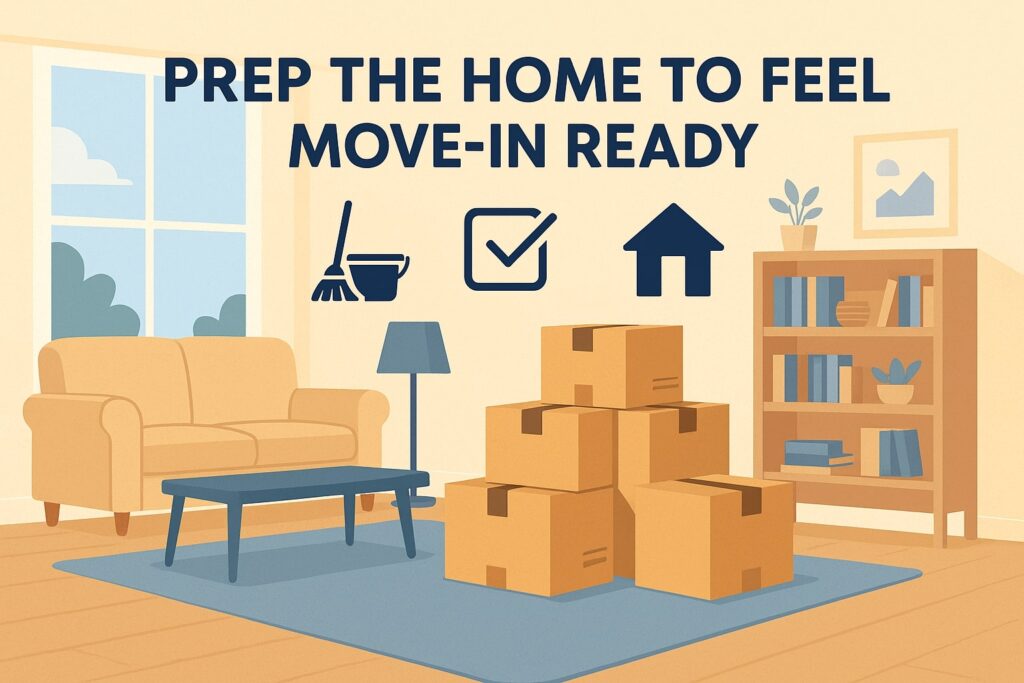
If you only remember one set of open house tips, remember this: buyers forgive small flaws, but they don’t forgive “work.” Your goal is to make the home feel cared for, clean, and simple to own.
- Preparation is not about perfection: It’s about removing friction. Friction is anything that distracts: sticky doors, worn caulk, cluttered counters, strong odors, dim lighting, dusty vents, or “mystery” stains. Each one adds a question in the buyer’s mind, and questions slow decisions.
- Start with a deep clean that goes beyond surfaces: Buyers notice baseboards, fans, windows, grout lines, and bathrooms. Then declutter to restore a sense of space. If a room feels tight, it reads as “not enough storage,” even if the floor plan is fine.
- Finally, walk the house like a first-time visitor: Take a slow lap from curb to kitchen to primary bedroom to backyard. Every moment should reinforce the same message: “This home is easy.” That’s one of the most timeless open house tips, and it wins in any market.
High-ROI Fixes Buyers Notice Immediately
Smart open house tips prioritize small improvements with big perception payoff. Think “confidence builders,” not costly renovations.
- Fix anything that looks unfinished: loose handles, squeaky hinges, burned-out bulbs, dripping faucets, wobbly toilets, and cracked switch plates. These don’t just look minor—they create doubt about maintenance and hidden issues.
Patch nail holes, touch up scuffs, and refresh caulk in kitchens and baths. If paint is tired, a neutral refresh can help photos and in-person impressions. - Lighting is a secret weapon: Bright homes feel bigger and cleaner. Use consistent color temperature bulbs, open blinds, and add lamps where corners look shadowy. Another overlooked upgrade is smell control.
Avoid heavy fragrances that feel like you’re hiding something. Instead, aim for “neutral-clean”: fresh air, trash out, litter boxes gone, and HVAC filters changed. - Don’t ignore curb appeal: The driveway, walkway, mailbox, and front door set the tone. One of the best open house tips is to make the entry feel welcoming—clean mat, tidy landscaping, and a front door that looks recently cared for.
Stage for Today’s Buyers and Tomorrow’s Trends
Modern open house tips treat staging as storytelling. Buyers don’t just tour rooms—they imagine routines. Where does coffee happen? Where do guests gather? Where does remote work fit? Staging answers those questions without saying a word.
Start by staging key spaces first: entry, living area, kitchen, primary bedroom, and the most valuable outdoor feature (deck, yard, patio). Keep it simple and intentional. Too much furniture makes rooms feel smaller. Too little makes them feel cold. Aim for “hotel-livable”: clean, calm, and aspirational.
It’s also smart to reflect current design preferences. Many listing descriptions and buyer tastes are shifting toward warmer, natural textures and refined simplicity—styles often described as “organic modern.”
Reports tied to Zillow’s analysis have highlighted that this look can help listings stand out and command premiums when presented well.
Staging isn’t only visual. It’s emotional. A staged home should feel quiet, bright, and easy. These open house tips make buyers slow down, linger longer, and form attachment—the three ingredients that lead to offers.
Use Virtual and AI Staging the Right Way
Digital-first buyers make virtual staging one of the most relevant open house tips—but only when done honestly and strategically. Virtual staging can help a vacant home feel warm and show scale. It can also help buyers imagine layout options. But it should never misrepresent fixed features like windows, fireplaces, or the size of rooms.
Some platforms are experimenting with AI-powered tools that let shoppers visualize furnishings or styles directly on listing photos, though early versions can be limited in impact and availability.
This trend still matters because it signals where buyer expectations are going: more interactive listings, more personalization, and less patience for empty rooms that feel hard to interpret.
Here’s how to apply these open house tips safely:
- Use virtual staging to support, not replace, real-world presentation.
- Match the virtual style to what buyers will actually see at the open house.
- Keep décor realistic for the neighborhood and price point.
- Disclose virtual staging where required or best practice—trust sells.
Future prediction: expect more “choose your style” listing experiences, where buyers toggle finishes or furniture looks. The best open houses will mirror that clarity by labeling spaces, showing optional layouts, and reducing guesswork.
Design a Buyer-Friendly Flow Through the Home
A strong open house feels effortless. Buyers should know where to go, what to notice, and how to imagine living there. These open house tips focus on flow: how people move, pause, and emotionally connect.
Start with a clean entry that signals space and calm. If the entry is tight, remove anything that blocks movement. Then create a natural path that highlights your best features early: a great kitchen, a bright living room, a view, or a renovated primary bath.
Avoid bottlenecks. In busy open houses, narrow hallways and small rooms can feel awkward. If possible, keep doors fully open, remove unnecessary furniture, and place subtle prompts that encourage one-way circulation (“Start here,” “Next room,” “Backyard this way”). The point is not to control buyers—it’s to reduce social friction so they explore more comfortably.
Finally, make it easy to “fall in love” and easy to “say yes.” Great open house tips anticipate the moment when buyers start picturing their furniture, their routines, their family. Your flow should support that imagination, not interrupt it.
Signage, Mini-Labels, and “Quiet Answers”
One of the most practical open house tips is to answer questions silently with simple, tasteful labels. Buyers don’t always want to ask. They may worry they’ll sound uninformed or get “sold.” Quiet answers keep them engaged.
Use small signs to highlight:
- Recent upgrades (“Roof replaced 2022,” “New HVAC 2023”)
- Hidden features (pantry, attic access, smart thermostat)
- Neighborhood perks (walkable spots, commuting routes, nearby parks)
- Utility clarity (where the breaker box is, what systems are gas/electric)
Also consider a “home highlights” sheet at the entry and another near the kitchen. Keep it short, scannable, and benefit-driven. Avoid gimmicks. Buyers respond to clarity.
This is where open house tips meet modern buyer behavior. Many visitors already read the listing, but they want proof. Labels feel like proof. They also help your host stay relaxed instead of repeating the same facts 50 times.
Market the Open House Like a Product Launch
If you want more buyers, you need more awareness—and the right message. The best open house tips treat promotion as a multi-channel campaign, not a single yard sign.
Start online because that’s where buyers decide whether your open house is worth attending. Your listing photos and description should match the in-person experience.
Use crisp visuals, a clean headline, and a benefits-first angle (“private yard,” “extra storage,” “true home office,” “easy parking”). A buyer who shows up is investing time. Your job is to make it feel worth it.
Then go hyperlocal. Neighbors can be your biggest amplifier. Many open houses attract “future sellers” who want to see how you present the home. That’s valuable energy—neighbors often refer friends or family who want to live nearby.
Finally, remember that marketing isn’t just reach. It’s targeting. Great open house tips focus on the buyer you want and the objections they might carry. If noise is a concern, show soundproofing.
If the layout is unique, show how it works. If insurance or climate risk is part of decision-making in your region, be ready with facts. Public attention to property risk data has grown, and buyers increasingly consider it in decision-making.
Photos, Short Video, and “Preview Value”
A powerful set of open house tips is to create “preview value”—content that makes buyers feel they’ll miss out if they don’t attend.
Short videos work because they show flow better than photos. A 30–60 second walk-through can highlight the best emotional moments: bright living room, kitchen, primary suite, backyard. Keep it steady, well-lit, and honest. If you have 3D tours or floor plans, use them to reduce confusion and increase qualified turnout.
Your promotional copy should be specific. “Beautiful home” is invisible. “Bright corner living room + updated kitchen + private yard” is tangible. Use the open house time, parking instructions, and one clear next step: “Come see it in person.”
Future prediction: more listing platforms and agents will use AI-assisted listing enhancement and dynamic media. The winners won’t be the flashiest. They’ll be the clearest. These open house tips will keep working because clarity scales.
Nail the Open House Experience and Keep It Safe
Open house day is performance day. But it shouldn’t feel like pressure. Your goal is a calm, welcoming environment where buyers can explore and imagine. The best open house tips create comfort without hovering.
Start with atmosphere: lights on, blinds open, comfortable temperature, soft background music (low volume), and a tidy “drop zone” near the entry for flyers and sign-in. Keep refreshment simple—bottled water is usually enough. Strong food smells can be distracting.
Then focus on safety and professionalism. Open houses involve strangers walking through private spaces. Safety guidance from the National Association of REALTORS® emphasizes situational awareness—knowing exits, keeping visibility, and using check-in practices.
Finally, make the experience buyer-friendly. Many buyers want to tour without being “pitched.” Your open house tips should include a greeting script that sets them at ease: a warm hello, a quick overview, and permission to explore.
Visitor Management, Scripts, and New Compliance Reality
A modern set of open house tips includes understanding shifting rules and expectations around representation and lead capture. Industry changes tied to the NAR settlement (effective in 2024) have influenced how agents discuss representation, disclosures, and sign-ins at open houses.
Even if you’re a homeowner hosting yourself, you can apply the same principle: be transparent and respectful. Ask visitors to sign in, but explain why (“for security and follow-up if you request info”). Offer a QR code option for speed. Don’t demand personal details beyond what’s reasonable.
Use a simple conversation flow:
- Welcome + confirm they’ve seen key info (price, beds, major upgrades)
- Ask what matters most to them (timing, features, budget comfort)
- Give them space to tour
- Offer to answer questions and suggest next steps (private showing, offer timeline)
These open house tips balance friendliness with professionalism. They also help you identify serious buyers without making casual visitors feel trapped.
Capture Leads and Follow Up Like a Pro
Open houses attract buyers—but the follow-up converts them. This is where many hosts fail. They get traffic, feel productive, and then… nothing happens. The best open house tips build a follow-up plan before anyone arrives.
Lead capture isn’t about being pushy. It’s about making it easy for interested buyers to take the next step. A sign-in sheet, QR code form, or tablet check-in can work. What matters is what you do next.
Follow-up should be fast, helpful, and specific. Within 24 hours, send a message that references what they saw and offers value: disclosures, upgrade list, neighborhood details, or a private showing window. You’re not chasing—you’re supporting a decision.
Also, categorize leads. Some are “today’s buyers.” Some are “watching the market.” Some are neighbors. Your open house tips should include different follow-ups for each group so you don’t waste time or annoy people.
Follow-Up Messages That Actually Get Replies
A high-converting open house tips framework is “Ask + Give + Option.” Keep messages short.
Example:
- Ask: “What did you think of the kitchen and backyard?”
- Give: “I can send the upgrade list and disclosures.”
- Option: “Would you prefer a private showing this week or updates if anything changes?”
If someone mentioned a concern (noise, layout, commute), address it directly with facts or a solution. Offer a second look at a quieter time. Share a floor plan with furniture ideas. Point out a nearby route that reduces commute stress.
Future prediction: follow-up will become more automated, but personalization will matter more. As buyers receive more templated messages, the hosts who reference real details will stand out. These open house tips keep your follow-up human, which is exactly what converts interest into action.
Reduce Buyer Doubts With an Information-First Setup
Buyers hesitate when they feel uncertain. Great open house tips reduce uncertainty by making information easy to access, easy to trust, and easy to verify.
Create an open house “info hub” near the kitchen or dining area:
- One-page highlights sheet (upgrades, utilities, HOA info if applicable)
- Disclosures packet availability (digital link is fine)
- List of included items (appliances, window treatments, smart devices)
- Neighborhood notes (walkability, nearby conveniences, commuting routes)
The key is tone. Your materials should feel like a service, not a sales pitch. Keep design clean and simple. Use bullet points. Use plain language. Avoid exaggerated claims.
Also prepare for common objections. If the home is smaller, focus on efficient layout and storage. If it’s older, highlight maintenance and system updates. If the backyard is limited, highlight nearby outdoor amenities. These open house tips turn “problems” into “tradeoffs,” which is how buyers actually decide.
Handling Questions Without Sounding Defensive
One of the most underrated open house tips is emotional control. When buyers critique, don’t argue. Don’t over-explain. Don’t panic. Curiosity wins.
Try:
- “That’s a fair question—what would you want this room to do for you?”
- “Totally hear you. Would it help to see a layout option?”
- “If you’re thinking about cost, I can share typical utility ranges or recent improvements.”
If a buyer asks about risks—like weather-related issues in certain areas—respond with transparency. Buyers increasingly want clear information, and there’s growing public discussion about how property risk data influences decisions. Transparency builds trust, and trust speeds offer.
These open house tips help you stay calm and helpful, which is exactly how serious buyers decide you’re credible.
Future Predictions: How Open Houses Will Evolve
Open houses aren’t going away, but they are changing. The next wave of open house tips is shaped by three forces: technology, buyer expectations, and transparency.
First, tech will make open houses more “guided” without feeling guided. Expect more QR-driven self-tours, interactive floor plans, instant access to disclosures, and personalized listing experiences.
AI staging and visualization tools are already appearing on major platforms, even if early versions are still limited. In the future, buyers will expect to visualize improvements, furniture layouts, and style changes quickly.
Second, buyer expectations are shifting toward lifestyle fit. Features tied to comfort, efficiency, and flexible living tend to get more attention. Design preferences like warmer natural finishes and “organic modern” aesthetics have been highlighted in Zillow-linked reporting as influencing buyer appeal and pricing outcomes.
Third, transparency will keep rising. Buyers want clearer info about costs, systems, and risks. Hosts who provide clean documentation, honest staging, and straightforward answers will outperform those who rely on hype. The most future-proof open house tips are the ones that reduce confusion.
The Open House of the Next 2–5 Years
To stay ahead, your open house tips should prepare for a hybrid model:
- More “appointment-like” structure layered on top of open access
- Digital sign-ins that feel secure and optional
- On-demand info packs and disclosure links
- Better storytelling about upgrades, efficiency, and long-term ownership ease
You’ll also see more emphasis on safety. Industry safety guidance already encourages practical awareness at open houses. As more homes integrate smart locks and cameras (within legal boundaries), open house procedures will likely become more standardized.
The future winner is simple: the host who makes the buyer feel informed, comfortable, and confident. That’s what the best open house tips have always done—and it’s what they’ll keep doing as tools evolve.
FAQs
Q.1: How early should I start preparing for an open house?
Answer: For best results, start 7–14 days before. The highest-impact open house tips—deep cleaning, decluttering, touch-up repairs, and staging—take longer than people expect.
Q.2: Do open houses really help sell a home faster?
Answer: They can, especially when they create urgency and reduce uncertainty. The strongest open house tips focus on presentation + promotion + follow-up, not just “doors open.”
Q.3: Should I offer refreshments?
Answer: Keep it simple. Water is usually enough. Heavy food smells can backfire. Clean, neutral atmosphere is one of the best open house tips for broad appeal.
Q.4: What’s the #1 staging mistake?
Answer: Too much furniture and clutter. One of the most reliable open house tips is to create space and light—buyers pay for how a home feels.
Q.5: Is virtual staging worth it?
Answer: Yes for vacant homes—if used honestly. Virtual/AI tools are growing, but should support reality, not replace it.
Q.6: How do I handle buyers who don’t want to sign in?
Answer: Offer a choice: quick QR sign-in or a simple visitor count with minimal info. Security and courtesy matter. These open house tips keep the tone respectful.
Q.7: How quickly should I follow up after the open house?
Answer: Within 24 hours. Fast follow-up is one of the highest-ROI open house tips because buyer interest cools quickly.
Q.8: What should I do if I get lots of visitors but no offers?
Answer: Review price positioning, listing clarity, and in-home friction (smell, lighting, clutter, unanswered questions). Then strengthen your follow-up. Often the fix is better open house tips in the details, not a full reset.
Conclusion
The best open house tips are not gimmicks. They’re a system: prepare the home to feel easy, stage it to tell a lifestyle story, market it like a launch, host it safely and calmly, and follow up with purpose.
When you apply these open house tips, you’re doing more than attracting more buyers—you’re increasing confidence. Confident buyers move faster, negotiate less aggressively, and feel comfortable paying for value.