
Renting vs Buying: Which Is Better?
“Renting vs buying” is one of those decisions that feels like it should have a universal answer—but it doesn’t. The better choice depends on how long you plan to stay, how stable your income is, what housing costs look like where you live, and how you value flexibility versus control. In other words, renting vs buying is part math and part lifestyle design.
The key is to stop treating the question like a debate and start treating it like a personal financial model. Renting vs buying is really about comparing two paths: one where you pay for flexibility and fewer responsibilities (renting), and one where you pay upfront costs to build equity and lock in housing stability (buying). Both can build wealth—just in different ways.
This guide breaks down renting vs buying using a clear framework: total monthly cost, hidden expenses, break-even timing, taxes, risks, and future trends. By the end, you’ll know exactly which numbers matter, how to estimate your break-even point, and how to choose a path that fits your life—not just your spreadsheet.
Understanding the True Cost of Renting vs Buying
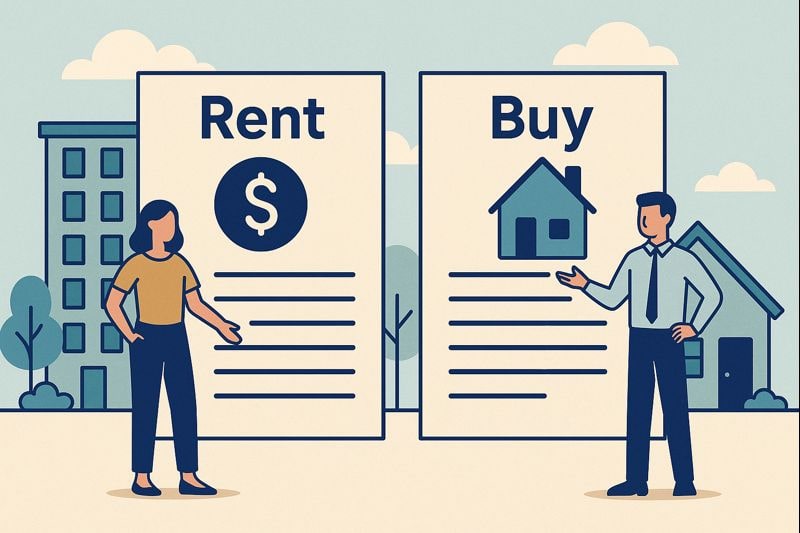
The biggest mistake people make in renting vs buying is comparing rent to mortgage payment as if they’re the same thing. They aren’t. A mortgage payment is just one slice of ownership, and rent is not the only cost of renting. To decide intelligently, renting vs. buying has to be compared as total housing cost.
For renting, your monthly rent is the obvious cost, but don’t ignore renter’s insurance, utilities that a landlord doesn’t cover, annual rent increases, moving costs, application fees, and the “soft costs” of frequent relocation. Renting vs. buying becomes clearer when you estimate how often you’re likely to move and what that costs in deposits, movers, and time.
For buying, the mortgage is only the start. Ownership includes property taxes, homeowners insurance, potential HOA dues, repairs and maintenance, and transaction costs. Many buyers also pay mortgage insurance depending on the down payment size.
Even if your monthly payment looks similar to rent, the “all-in” cost can be meaningfully higher—especially in the early years when interest dominates your amortization schedule.
A strong renting vs. buying comparison uses a 3-layer view: (1) monthly cash flow, (2) upfront and exit costs, and (3) long-term wealth impact. When you calculate all three layers, you stop guessing and start choosing.
Renting vs Buying and the Break-Even Point
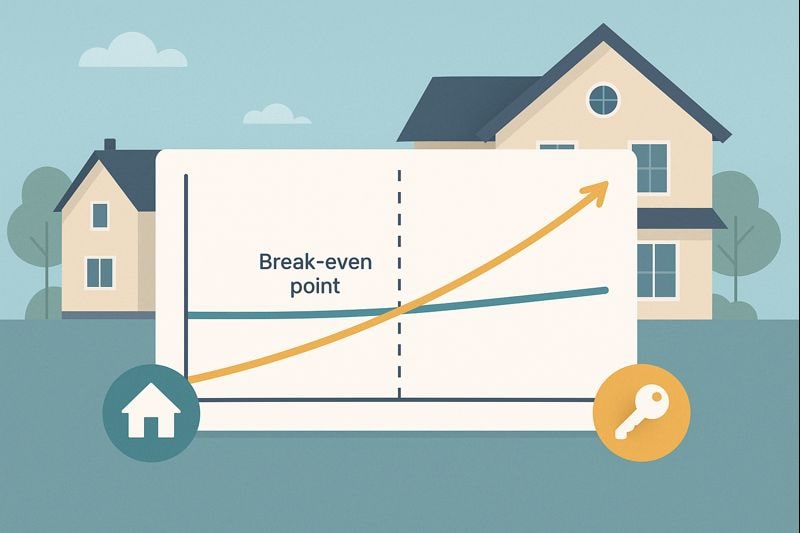
In renting vs. buying, the break-even point is the moment when buying becomes cheaper than renting after you account for upfront costs. It’s not a slogan like “buy if you’ll stay five years.”
That old rule is being challenged in many markets because high prices and transaction costs can push break-even further out. Some recent analysis suggests break-even can approach a decade in certain scenarios.
Break-even depends on a few big drivers:
- How long you’ll stay (time spreads closing costs over more years)
- Price-to-rent ratio (expensive homes compared to rent delay break-even)
- Interest rate and loan terms (higher rates increase interest cost early on)
- Home appreciation (faster appreciation improves buying outcomes, but isn’t guaranteed)
- Rent growth (fast rent inflation makes owning comparatively better over time)
- Opportunity cost (money tied up in a down payment could be invested elsewhere)
When you buy, you usually pay closing costs and later pay selling costs (often including agent commissions). Those two costs alone can be a major reason for renting vs buying break-even shifts from 3–5 years to 7–10 years in some markets.
A practical way to evaluate renting vs. buying is to set a “likely stay” range (for example, 3 years, 5 years, 8 years, 10 years). Then compare outcomes at each point. If buying only looks better at 10 years but you might move at 4, renting vs buying likely leans toward renting.
Cash Flow Reality: Monthly Payment vs Monthly Lifestyle
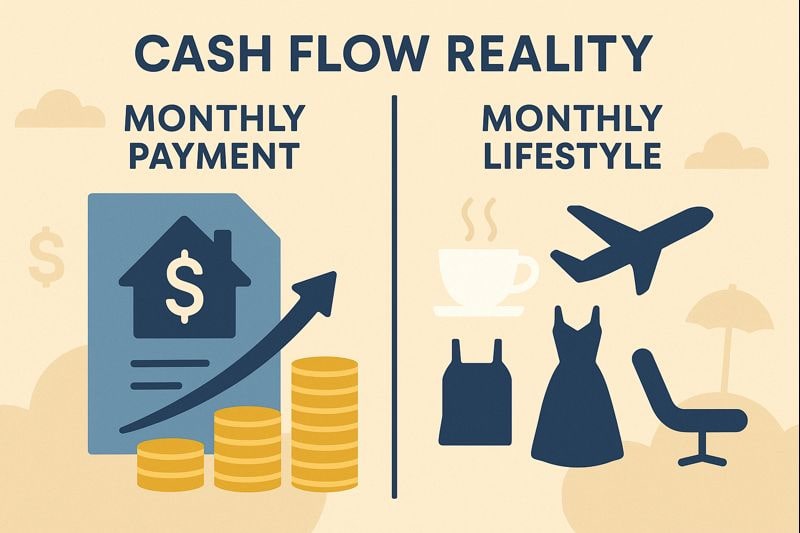
Renting vs buying often feels like a math problem, but the first decision gate is cash flow safety. Even if buying wins long-term, it can be a bad choice if your monthly budget becomes fragile.
Renting tends to be more predictable month to month. Your rent may rise at renewal, but you typically avoid surprise bills for a roof leak, appliance replacement, or property tax reassessment. That predictability can make renting vs buying lean toward renting for people with variable income, large existing debt, or uncertain job stability.
Buying can stabilize housing costs over time—especially with a fixed-rate mortgage—because the principal-and-interest portion doesn’t change. But your total payment can still rise due to taxes and insurance.
Many owners also underestimate the “ownership buffer”: the money you need to keep available for repairs, maintenance, and unexpected issues. In renting vs buying, the owner should assume some level of annual maintenance spending, even if the home is in good condition.
Cash flow also includes lifestyle priorities. If you want the freedom to travel, change neighborhoods, or take career risks, renting vs buying may favor renting because it reduces fixed obligations.
If you prioritize stable monthly housing and the ability to customize your space, renting vs buying may favor buying—provided your budget can handle it.
The best renting vs buying outcome is the one that keeps you financially resilient. A technically “better” investment is not better if it forces you into paycheck-to-paycheck stress.
Upfront Costs: The Hidden Weight in Renting vs Buying
In renting vs buying, upfront costs are the reason many people misjudge affordability. Renting typically requires a security deposit and maybe first month’s rent upfront. Buying usually requires a down payment plus closing costs, inspections, and cash reserves.
Down payment size affects more than just whether you qualify. It also changes your monthly cost (loan size), mortgage insurance requirements, and your financial flexibility after closing.
A larger down payment can make renting vs buying tilt toward buying because it lowers monthly payments and long-term interest. But it can also weaken your emergency fund, which is risky.
Closing costs can be substantial and include lender fees, escrow setup, title charges, and prepaid items. These costs are one reason renting vs buying break-even may take longer than expected. And buying often triggers immediate spending: furniture, tools, paint, landscaping, and “we should fix this soon” projects.
Don’t forget exit costs. Many buyers focus on getting into a home and ignore what it costs to sell. In renting vs buying, selling costs can erase years of equity gains if you move too soon. That’s why the time horizon is so central.
If your savings are limited, renting vs buying may favor renting until you can comfortably cover: down payment, closing costs, moving costs, and an emergency cushion. A purchase that empties your reserves is financially unstable—even if it looks good on paper.
Equity Explained: What You Really Build When You Buy
Equity is the emotional centerpiece of renting vs buying—“rent is throwing money away” is a common line. But the truth is more nuanced. In renting vs buying, equity is not guaranteed profit; it’s a mix of principal paydown, market changes, and transaction costs.
When you pay a mortgage, part of the payment goes to interest and part to principal. Early in the loan, the interest portion is usually higher, meaning equity builds slowly. Over time, the principal portion grows.
This amortization reality is why renting vs buying outcomes can look weak in the first few years—especially if your interest rate is high.
Equity also depends on home value. If prices rise, your equity grows faster. If prices fall, you can lose equity, and selling can become difficult without bringing cash to closing. That market risk is a real factor in renting vs buying.
There’s also “forced savings.” Buying forces many people to build wealth because they consistently pay down principal and hold an asset. Renting vs buying can favor buying for people who struggle to invest consistently. But if you’re disciplined and invest the savings you get from renting, renting vs buying can favor renting financially.
So equity is powerful, but not magical. In renting vs buying, the best approach is to treat equity as a potential benefit—not as the entire argument.
Maintenance, Repairs, and Time: The Ownership Cost People Forget
Renting vs buying isn’t only about money. It’s also about time, responsibility, and stress tolerance. Renting generally means you call the landlord when something breaks. Buying means you are the landlord.
Maintenance is not a single expense—it’s a stream of small costs and occasional big hits: HVAC repairs, water heaters, roof work, plumbing surprises, pests, appliance replacement, yard care, and more. In renting vs buying, owners should plan for ongoing maintenance spending and keep a reserve for emergencies.
Time is another hidden cost. Owning often comes with tasks: coordinating contractors, doing DIY projects, seasonal upkeep, and handling warranties and insurance claims. If your time is limited or you travel frequently, renting vs buying may favor renting because it frees up your schedule.
That said, some people love ownership responsibility. They enjoy improving a home, making upgrades, and controlling their environment. In renting vs buying, this “control value” matters. If customization, pets, privacy, and long-term stability are top priorities, buying can deliver value that doesn’t show up in spreadsheets.
A realistic renting vs buying decision puts maintenance into your model as both money and time. If you ignore it, buying often looks better than it truly is.
Taxes and Incentives in Renting vs Buying
Taxes can influence renting vs buying, but they rarely provide a universal answer. In many cases, tax benefits are smaller than people expect because you only benefit if you itemize deductions rather than take the standard deduction.
Home mortgage interest may be deductible under certain conditions, and the IRS provides guidance on what qualifies and how limits apply. But the practical takeaway for renting vs buying is this: don’t assume you’ll get a big tax break unless you’ve actually estimated it based on your income, deduction strategy, and loan size.
Loan limits and mortgage market rules also matter for affordability. For example, conforming loan limits affect what can be financed through conventional channels and can shape interest rates and qualification standards.
The housing regulator announced a baseline conforming loan limit for one-unit properties for 2025 of $806,500 in most areas. This doesn’t mean you should borrow that much—only that the financing landscape shifts around those thresholds.
On the renting side, renters typically don’t receive large federal tax benefits related directly to housing costs. Renting vs buying can lean toward buying for households that meaningfully benefit from itemized deductions, but that outcome is highly individual.
A smart renting vs buying approach is to treat taxes as a “plus or minus,” not the foundation of the decision. Estimate your real-world tax difference before you count it as a reason to buy.
Market Conditions: Interest Rates, Prices, and Rent Growth
Market conditions can flip renting vs buying results quickly. Interest rates affect how expensive it is to finance a home, and even small changes can dramatically alter monthly payments and lifetime interest.
Recent reporting shows 30-year fixed mortgage rates around the low-6% range in late 2025, based on Freddie Mac’s weekly survey reported by major outlets. That context matters because renting vs buying math is sensitive to rates: higher rates push break-even further out, while lower rates can make buying more attractive.
Forecasts also matter for future planning. Housing outlook research from a major mortgage market institution projected mortgage rates ending 2025 around 6.4% and ending 2026 around 6.0% (forecast values can change, but it provides a directional view).
For renting vs buying, that implies the cost of borrowing may ease modestly, but not necessarily return to ultra-low levels soon.
Rent growth is the other side of the equation. If rents rise quickly, renting becomes more expensive over time, and renting vs buying may favor buying sooner. If rents stabilize or concessions increase, renting vs buying may favor renting longer—especially if home prices remain elevated.
A practical strategy is to run renting vs buying scenarios under three assumptions: conservative (slow appreciation, moderate rent growth), baseline, and optimistic. If buying only wins under optimistic assumptions, renting may be the safer choice.
Lifestyle Fit: Mobility, Career, Family, and Personal Values
Some renting vs buying decisions are obvious once you stop forcing them to be purely financial. The “better” option is the one aligned with your likely life path over the next several years.
Renting vs buying often favors renting if you expect job changes, relocation, or major life transitions. Renting can make it easier to move for career opportunities, adjust to changing household size, or test a neighborhood before committing. Flexibility is a real asset—especially when your future is uncertain.
Renting vs buying may favor buying when stability is a priority: consistent schooling, long-term community ties, and a strong desire to control your environment. Homeownership can also support long-term planning—custom upgrades, accessibility modifications, and the ability to keep pets without restrictions.
Values matter too. Some people value the simplicity of renting and prefer to invest elsewhere. Others value the pride of ownership and the ability to build a long-term home. Renting vs buying is not only about maximizing net worth; it’s about designing a life you can sustain.
If you’re torn, pick the option that reduces regret risk. For many people, the biggest regret is buying too soon and needing to sell quickly. For others, it’s waiting too long and feeling priced out. Renting vs buying is best solved by matching the option to your most likely future, not your idealized one.
How to Decide: A Step-by-Step Renting vs Buying Framework
If you want a clear path through renting vs buying, use this framework. It’s simple, practical, and works regardless of your market.
Step 1: Define your time horizon
Write down the most likely number of years you’ll stay: 3, 5, 7, 10+. Time horizon is the backbone of renting vs buying because transaction costs punish short stays.
Step 2: Calculate your “all-in” monthly cost to own
Include mortgage principal and interest, taxes, insurance, HOA, and maintenance reserve. Compare that to rent plus renter’s insurance and utilities differences. Renting vs buying becomes real when you compare totals, not slogans.
Step 3: Estimate upfront and exit costs
Down payment, closing costs, immediate move-in spending, and potential selling costs. If these numbers feel heavy, renting vs buying may favor renting until you build stronger reserves.
Step 4: Add opportunity cost
If you rent, could you invest the down payment difference? If you buy, does ownership force you to save? This is where renting vs buying becomes personal.
Step 5: Stress-test three scenarios
Run conservative, baseline, and optimistic assumptions. If buying only wins in the optimistic case, renting vs buying likely favors renting.
Step 6: Decide based on both math and fit
If the math is close, let lifestyle decide. Renting vs buying doesn’t need a perfect answer—it needs a confident, sustainable answer.
This framework isn’t just “renting vs buying advice.” It’s a repeatable decision tool you can use anytime your housing situation changes.
Future Prediction: Where Renting vs Buying May Be Headed
The future of renting vs buying will likely be shaped by three forces: interest rates, supply constraints, and household mobility. While forecasts can be wrong, multiple outlooks suggest mortgage rates may remain in a moderate range with potential modest easing into 2026 rather than a quick return to the extremely low-rate era.
If rates stay around the current range, renting vs buying decisions may increasingly depend on local price-to-rent ratios and how much new housing supply comes online. In markets where prices remain high relative to rent, break-even periods can stay long, pushing some households toward renting longer—especially if they expect to move.
At the same time, continued rent growth can make renting vs buying tilt back toward buying for households who can lock in stable payments and stay put long enough to amortize transaction costs.
The balance may become more neighborhood-specific than ever: two areas in the same metro can have completely different renting vs buying outcomes due to rent levels, HOA burdens, taxes, and appreciation patterns.
A realistic “future-ready” approach to renting vs buying is to keep your finances flexible. Build reserves, keep your credit strong, and avoid overcommitting to a mortgage that only works if everything goes perfectly. In the coming years, the best housing strategy may be the one that gives you options.
FAQs
Q.1: Is renting vs buying better for building wealth?
Answer: Renting vs buying can build wealth either way. Buying builds wealth through equity and potential appreciation, but it comes with transaction costs and maintenance. Renting can build wealth if you invest the savings and keep your lifestyle costs controlled. The better wealth path depends on your discipline, time horizon, and local market conditions.
Q.2: How long should I stay for buying to beat renting vs buying math?
Answer: There’s no universal number. In some situations the break-even can be around five years, but recent analysis suggests it can stretch closer to a decade in certain higher-cost scenarios. The safest method is to model outcomes at 3, 5, 7, and 10 years using your actual numbers.
Q.3: Does a fixed-rate mortgage automatically make renting vs buying better?
Answer: Not automatically. A fixed-rate mortgage can stabilize principal-and-interest payments, but taxes, insurance, HOA dues, and maintenance still change. Renting vs buying depends on total cost and how long you’ll stay, not just the rate type.
Q.4: Are tax benefits a strong reason in renting vs buying?
Answer: Sometimes, but not always. Mortgage interest deductions and related rules can help, but many households don’t see huge benefits if they don’t itemize. IRS guidance explains the rules, but the practical impact is personal and should be estimated before deciding.
Q.5: Should I wait for rates to drop before deciding renting vs buying?
Answer: Waiting can work, but it’s a gamble. Rates may ease modestly based on some forecasts, but timing markets is hard. Renting vs buying is better decided by your readiness: stable income, strong reserves, manageable payment, and a long enough time horizon.
Q.6: What’s the biggest mistake people make in renting vs buying?
Answer: Comparing rent to mortgage payment without adding all ownership costs. The second biggest mistake is buying with an uncertain time horizon. Renting vs buying is less about “what’s best” and more about “what fits your real life.”
Conclusion
Renting vs buying is not a one-size-fits-all decision, and anyone who tells you otherwise is oversimplifying. The best choice is the one that matches your time horizon, protects your cash flow, and aligns with your lifestyle priorities.
If you value mobility, predictability, and low responsibility—or if you’re unsure you’ll stay put—renting vs buying often favors renting. If you’re financially stable, plan to stay long enough to overcome transaction costs, value control and long-term housing stability, renting vs buying often favors buying.
The winning move is to compare renting vs buying using total costs (monthly, upfront, and exit), including maintenance and opportunity cost, and stress-test conservative scenarios. When you do that, the decision becomes clearer—and you can move forward without second-guessing.